Every great story needs a storyteller, and in the world of Indian cultural dance, that storyteller often speaks without saying a word. Abhinaya the ancient art of expression is what turns rhythmic movement into myth, memory, and meaning. In this post, we’ll explore what Abhinaya is, how its four pillars work together, and why it remains the beating heart of Indian cultural dance today.
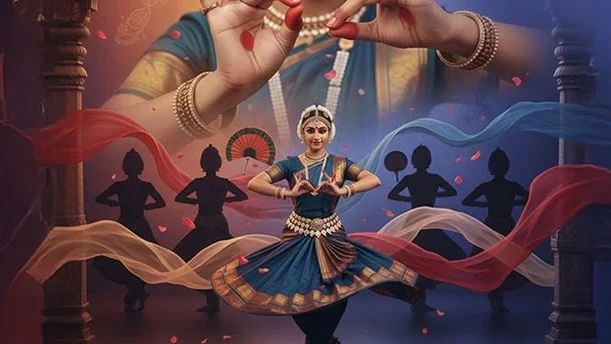
What Abhinaya Means and Why It Matters
Abhinaya comes from the Sanskrit roots “abhi” (towards) and “ni” (to carry), and it literally means to lead an audience toward an experience. That experience is emotional, not just visual. The goal is to make a viewer feel the story, not simply watch it unfold. This is what separates Indian cultural dance from purely decorative movement.
The concept is rooted in the Natya Shastra, an ancient Sanskrit treatise on performing arts traditionally credited to the sage Bharata Muni. Composed roughly between the 2nd century BCE and 2nd century CE, it laid down the grammar of gesture, expression, and emotion that classical dancers still follow. Nearly every Indian classical dance style Bharatanatyam, Kathak, Odissi, and more traces its expressive vocabulary back to this single foundational text.
Understanding Abhinaya, then, isn’t just understanding a dance technique. It’s understanding a centuries-old system for transmitting emotion, myth, and meaning from performer to audience is one of the reasons Indian cultural dance has survived and thrived for thousands of years.
The Four Pillars: Angika, Vachika, Aharya, Sattvika
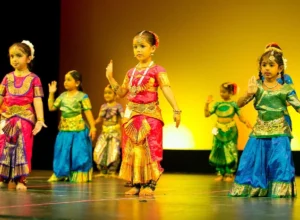
Classical theory organizes Abhinaya into four interlocking types, each responsible for a different channel of storytelling. Angika Abhinaya expresses through the body the sweep of an arm, the tilt of the head, the flicker of an eyebrow. It’s usually the most visible layer of a performance, and often the first thing that draws an audience in.
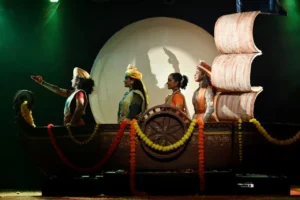
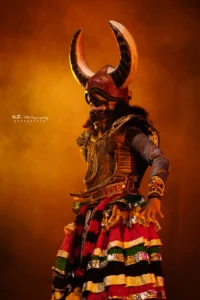
Vachika Abhinaya is the vocal thread of the story, carried through sung lyrics, recited verse, or spoken dialogue that the dancer interprets through gesture. In Kathak, performers sometimes narrate directly to the audience using a technique called Padhant, while in Kuchipudi, dancers occasionally mouth the words of the song themselves. Aharya Abhinaya, meanwhile, is expression through costume, jewelry, makeup, and props visual cues that instantly tell an audience who a character is, long before a story begins.
The fourth pillar, Sattvika Abhinaya, is widely considered the hardest to master. It’s the internal, deeply felt dimension of expression genuine emotion rather than technical execution and it can’t be faked through gesture alone. Together, these four pillars form a complete language, similar in spirit to how body language and acting inform expressive performance more broadly across the performing arts.
Rasa and the Navarasa: How Emotion Becomes Story
The entire purpose of Abhinaya is to produce rasa the aesthetic emotional “flavor” experienced by the audience. It isn’t enough for a dancer to feel something internally; that feeling has to travel successfully from performer to viewer. This transmission is what separates a technically correct performance from a genuinely moving one, and it’s central to why classical dance carries such deep cultural weight in Indian society.
Rasa theory identifies nine primary emotions, known as the Navarasa: love, laughter, compassion, anger, courage, fear, disgust, wonder, and peace. Bharata Muni’s original text described eight of these; the ninth, peace (Shanta), was added later by the philosopher Abhinavagupta. Nearly every mythological story performed in Indian cultural dance from Krishna’s playful mischief to Draupadi’s grief can be traced back to combinations of these nine core emotions.
This is what gives classical dance its narrative depth. A single piece might move a dancer through love, then anger, then sorrow, then peace, all within a few minutes and a well-trained audience can follow every shift without a single spoken word.
Mudras and the Body as Narrator
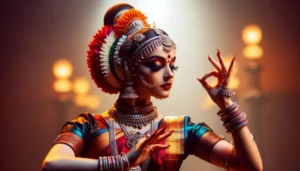
Hand gestures, or mudras, are the most codified storytelling tool within Angika Abhinaya. Bharatanatyam alone uses more than 50 single-hand gestures and over 20 double-hand gestures, each carrying its own specific meaning. A single mudra like Pataka can represent a flag, a command to stop, or a blessing the meaning shifts entirely depending on the story being told.
This precision is part of why Indian cultural dance is often described as a visual language rather than a performance style. Combined with facial expression and subtle eye movement, mudras allow a dancer to narrate complex plots, a battle, a journey, a divine miracle using only their hands and face. It’s a skill built over years of training, closely tied to the discipline and personal growth that comes from committed classical practice.
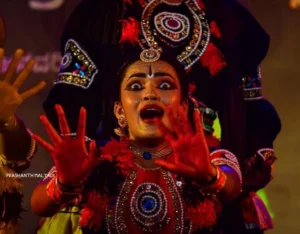
Facial expression carries equal weight in this vocabulary. The face becomes a landscape of feeling a slight narrowing of the eyes, a raised brow, a soft downward gaze each carrying as much narrative information as a spoken sentence.
One Dancer, Many Characters Abhinaya in Action
Perhaps the most striking feature of solo Indian classical dance is the ability of a single performer to portray multiple characters within one piece. By shifting posture, gaze direction, and expression, a dancer can move seamlessly between a hero, a villain, a lover, and a narrator sometimes within the same phrase of music. This technique allows one artist to stage an entire mythological episode alone, without props, dialogue, or a supporting cast.
While the underlying grammar of Abhinaya is shared, each classical style adds its own accent. Bharatanatyam favors sculptural stillness and precise geometric posture, while Kathakali leans on elaborate makeup and highly stylized facial codes to portray gods and demons. This diversity is part of what keeps India’s performing arts scene so vibrant across different regions and communities today.
Bringing the Story Full Circle
Abhinaya is what transforms Indian cultural dance from a sequence of movements into a living, breathing story. Through the four pillars Angika, Vachika, Aharya, and Sattvika and through the emotional vocabulary of the Navarasa, dancers carry centuries-old myths and emotions directly to a modern audience. It’s a tradition that rewards close attention, and one that reveals something new with every performance.
If you’d like to see Abhinaya in motion rather than just read about it, there’s no substitute for experiencing a live performance or better yet, learning the art form yourself. Explore our classes and upcoming performances to begin your own journey into the expressive world of Indian cultural dance.
Faqs
What is Abhinaya in Indian classical dance?
Abhinaya is the art of expression in Indian classical dance a system of gesture, facial expression, and body movement used to convey stories and emotions directly to an audience, without relying on spoken dialogue.
What are the four types of Abhinaya?
The four types are Angika (body movement), Vachika (voice, song, and recitation), Aharya (costume, makeup, and props), and Sattvika (internal, genuinely felt emotion). Together they form the complete expressive vocabulary of Indian cultural dance.
What is the Navarasa in dance?
The Navarasa refers to the nine core emotions in Indian aesthetic theory love, laughter, compassion, anger, courage, fear, disgust, wonder, and peace. Dancers use these emotions as building blocks to tell mythological and human stories through Abhinaya.
What are mudras and why are they important?
Mudras are symbolic hand gestures used in Indian cultural dance to represent objects, actions, or emotions. Bharatanatyam alone has over 70 documented hand gestures, each capable of carrying multiple meanings depending on context.
Which Indian classical dance forms use Abhinaya?
Abhinaya is common to nearly all major classical styles, including Bharatanatyam, Kathak, Odissi, Kuchipudi, Kathakali, Manipuri, and Sattriya. Each style interprets the same underlying grammar with its own regional character.